6 Projected housing gaps
6.1 Overview
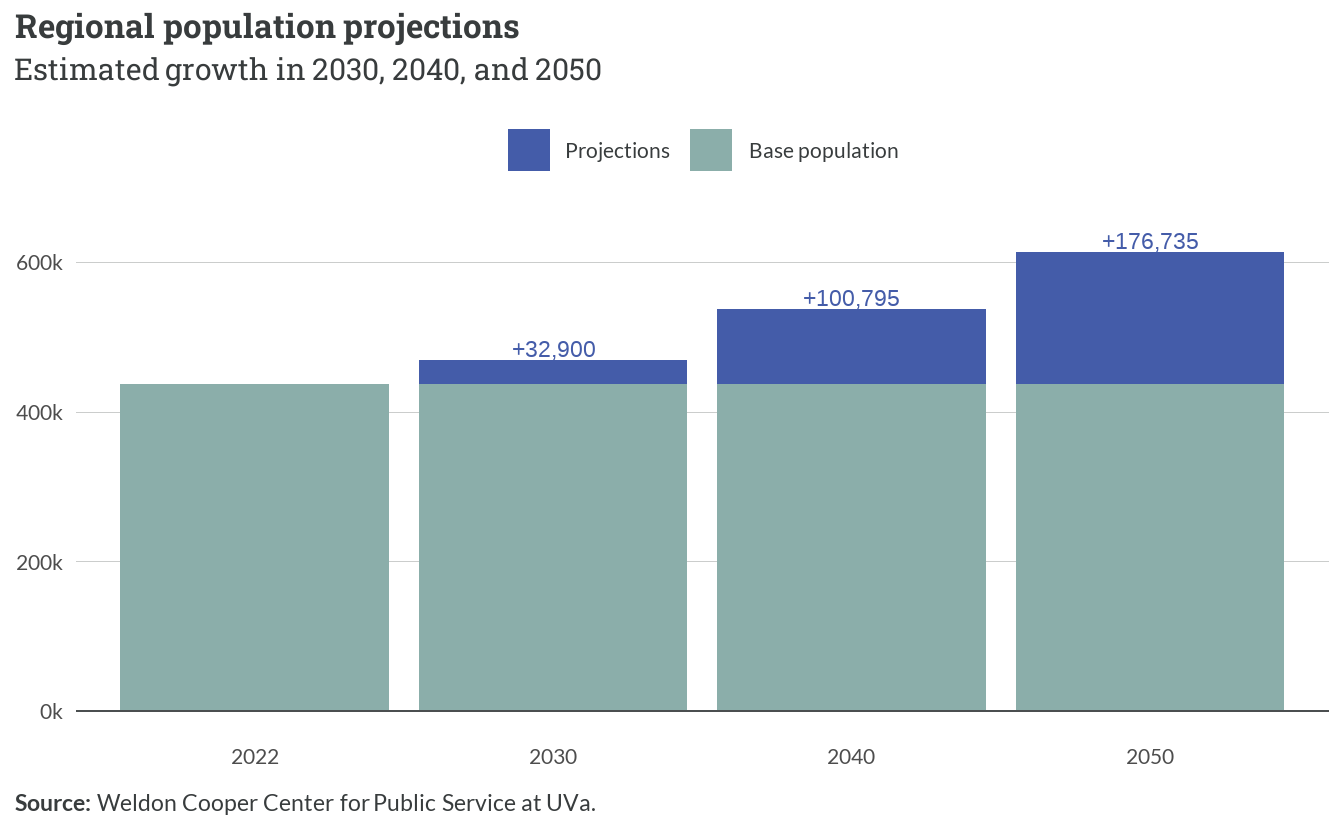
This section uses population projections from the Weldon Cooper Center for Public Service at UVa to estimate new households that will be added to the region between now and 2050. As the chart below shows, the region can expect significant population growth over the coming decades.
The Fredericksburg region’s population is projected to grow substantially, with increasingly larger increments each decade. Starting from 2022, the region will add approximately 32,900 residents by 2030, followed by an additional 67,895 residents from 2030 to 2040.
The most significant growth is expected between 2040 and 2050, with 75,940 new residents. This accelerating growth pattern suggests the region will need to plan for a cumulative increase of more than 176,000 residents over the next three decades.
6.2 Household projections
Household projections indicate a steady upward trajectory in new household formation across the region. The data shows an initial addition of 11,527 households by 2030, followed by 23,790 new households between 2030 and 2040. The final decade sees the largest increment with 26,609 new households formed between 2040 and 2050. In total, the region is expected to accommodate approximately 61,926 new households by 2050, suggesting a significant need for housing expansion.
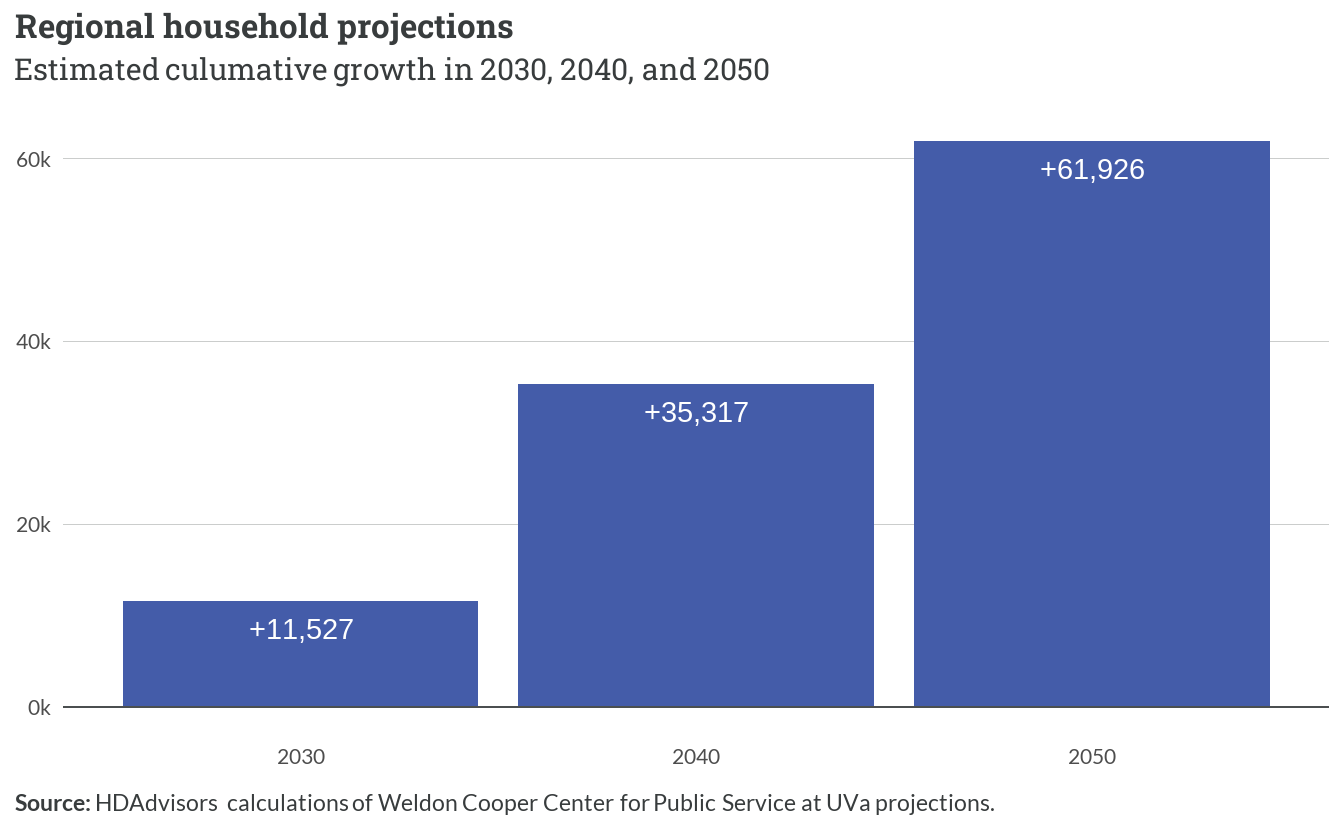
At that rate, the region will need to house roughly 2,400 new households each year between now and 2050.
Local projections
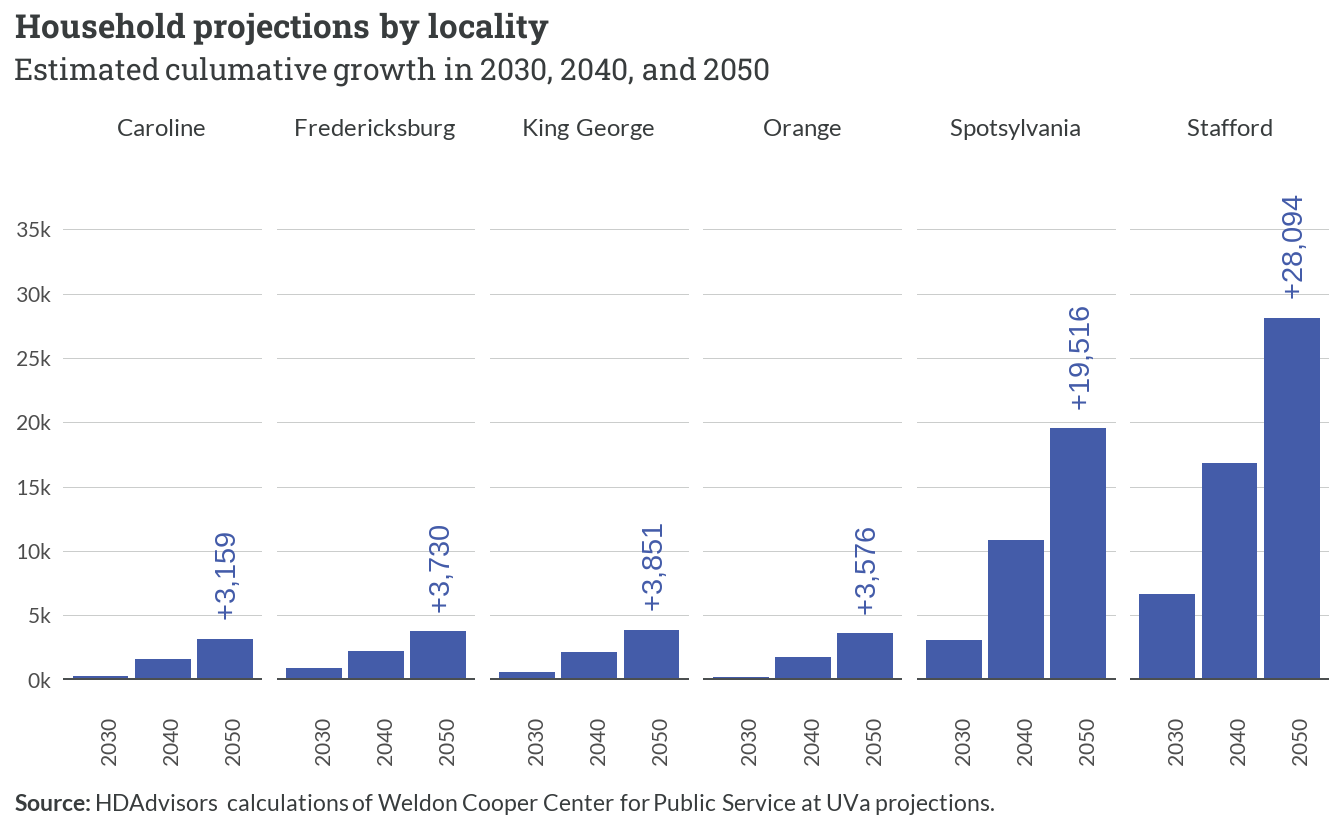
The household growth projections reveal stark differences in distribution across localities. Stafford County leads with the highest projected growth of 28,094 households by 2050, followed by Spotsylvania with 19,516 new households.
The remaining localities show more modest growth patterns, with Caroline, Fredericksburg, King George, and Orange each projected to add between 3,100 and 3,900 households by 2050. This uneven distribution suggests housing demand and development pressures will be particularly concentrated in the region’s northern jurisdictions.